
High Summer

“Once there were brook trout in the streams in the mountains. You could see them standing in the amber current where the white edges of their fins wimpled softly in the flow. They smelled of moss in your hand. Polished and muscular and torsional. On their backs were vermiculate patterns that were maps of the world in its becoming. Maps and mazes. Of a thing which could not be put back. Not made right again. In the deep glens where they lived all things were older than man and they hummed of mystery.”1
— Cormac McCarthy
Admittedly, it has been a long time since I have had the opportunity to craft a post here. Late May feels like a long time ago indeed. Much has changed since then, particularly from a phenological standpoint.
I also realize I am rapidly approaching the one year anniversary of “Letters from Labrador!” Before I launch into this new piece, I’d like to express gratitude for all of you who have been following these dispatches — some who started reading right from the beginning; others who are recent subscribers. Additionally, I want to offer a heartfelt thank you to those who pledged monetary support toward these endeavors. As one who cobbles together a livelihood through self-employment and various creative pursuits, every little bit adds up and truly goes a long way!
Looking back at my inaugural entry, “Headwaters: Part I,” I am somewhat incredulous that this time last year was so wet. I referenced the fact that we were around 9” above average in terms of precipitation for that point of the year. Ironically enough, shortly thereafter, our region entered a prolonged dry period that became a bonafide drought. Soil moisture became dangerously parched and weather patterns stalled with abundant sun and wind.
On one particularly gusty, November day last autumn, a wildfire sparked nearby when a tree limb fell across a utility line. I know the folks whose home was almost consumed by the flames. When Bob tried to turn on the outside faucet to fight the fire, no water emerged, because the power was out! Our local fire chief, commenting after the incident, remarked that if it had taken the fire department even a few additional minutes to respond — the house would have been leveled. Mind you, this is western Massachusetts, not southern California.
Even though it was a cold, snowy, “old fashioned” winter (the first in close to a decade), the drought persisted into spring, and full recovery didn’t occur until May. By the middle of June, the region was again above average for yearly precipitation. Yet here we are again, over a month without appreciable rain (there are light showers today, thankfully).
Though Franklin County hasn’t registered on the U.S. Drought Monitor (as of yet), soil moisture is depleted, and local streamflows are down considerably. Watering the gardens is an everyday job. Yesterday, the 26th of July, the air quality index spiked due to wildfire smoke drifting down from Canada.
Although I have learned to temper my “climate anxiety” during stretches such as these, I nevertheless feel a heightened degree of agitation, disappointment, and anger. If it’s not flash drought, the next phase could easily be a flash flood. These transitions often turn on a dime, inducing a kind of whiplash effect that in previous decades was almost unheard of.
But enough doom and gloom for now. I thought I would recount an unexpected, “silver-lining” moment that manifested three years ago during a similarly dry summer period.
***
As many of you know from previous entries, I often write about the small brook which flows about a hundred yards north from my back door. The presence of this waterway is a source of much joy and contemplation. Over the course of the seven years that I have lived here, I have seen it both as a raging torrent, and as a bone-dry conglomeration of dusty rock.
The brook, in the words of Robinson Jeffers, “Drain[s] the mountain wood.”2 Originating in the hills east of my home, it descends rapidly in elevation before eventually spilling into the Connecticut River, having travelled a total distance of roughly three miles. Its source is mainly underground springs, and the water is cold, clear, and well oxygenated. At least three species of native fish inhabit the stream: Brook Trout, Eastern Blacknose Dace, and Slimy Sculpin. Additionally, myriad amphibians, macro invertebrates, insects, mammals, and birds all benefit from this life-giving artery.
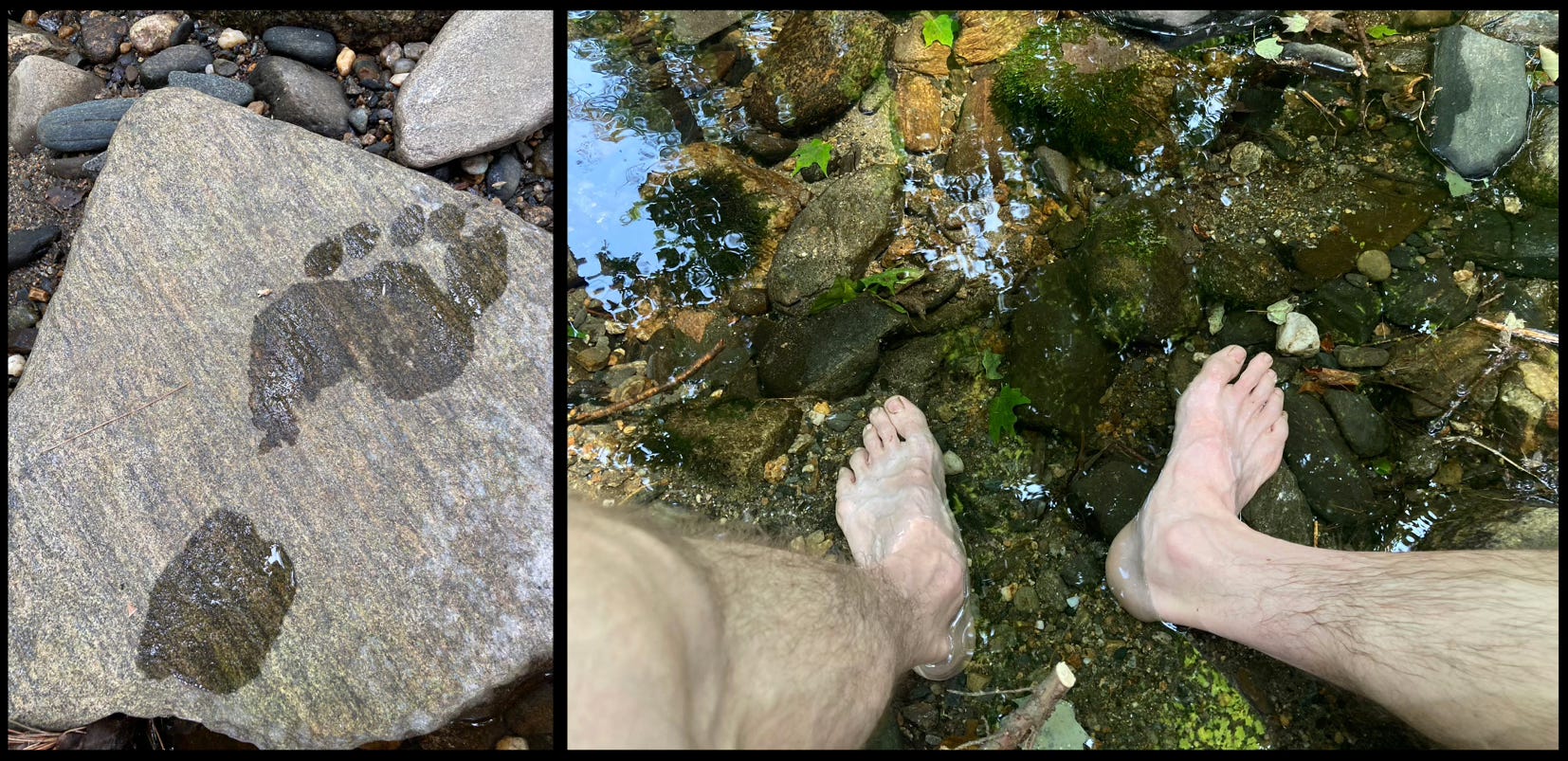
In 2022, by the middle of July, people stopped mowing their grass as neighborhood lawns browned to a crisp. I kept a close eye on the brook, watching concernedly as its depth dwindled.
One of my neighbors, John, has lived here his whole life. He was born a tad over half-a-mile up the road from where he and his wife currently reside. At 83, he is my go-to source for first-hand historical accounts, and unbeknownst to him, offers me a unique glimpse into what my hometown was like decades ago.
During the summer of 2021, parts of New England experienced generational flooding. The little brook that flows through our neighborhood became Class II whitewater, and its fury took out bridges, culverts, and portions of roads during the deluge.
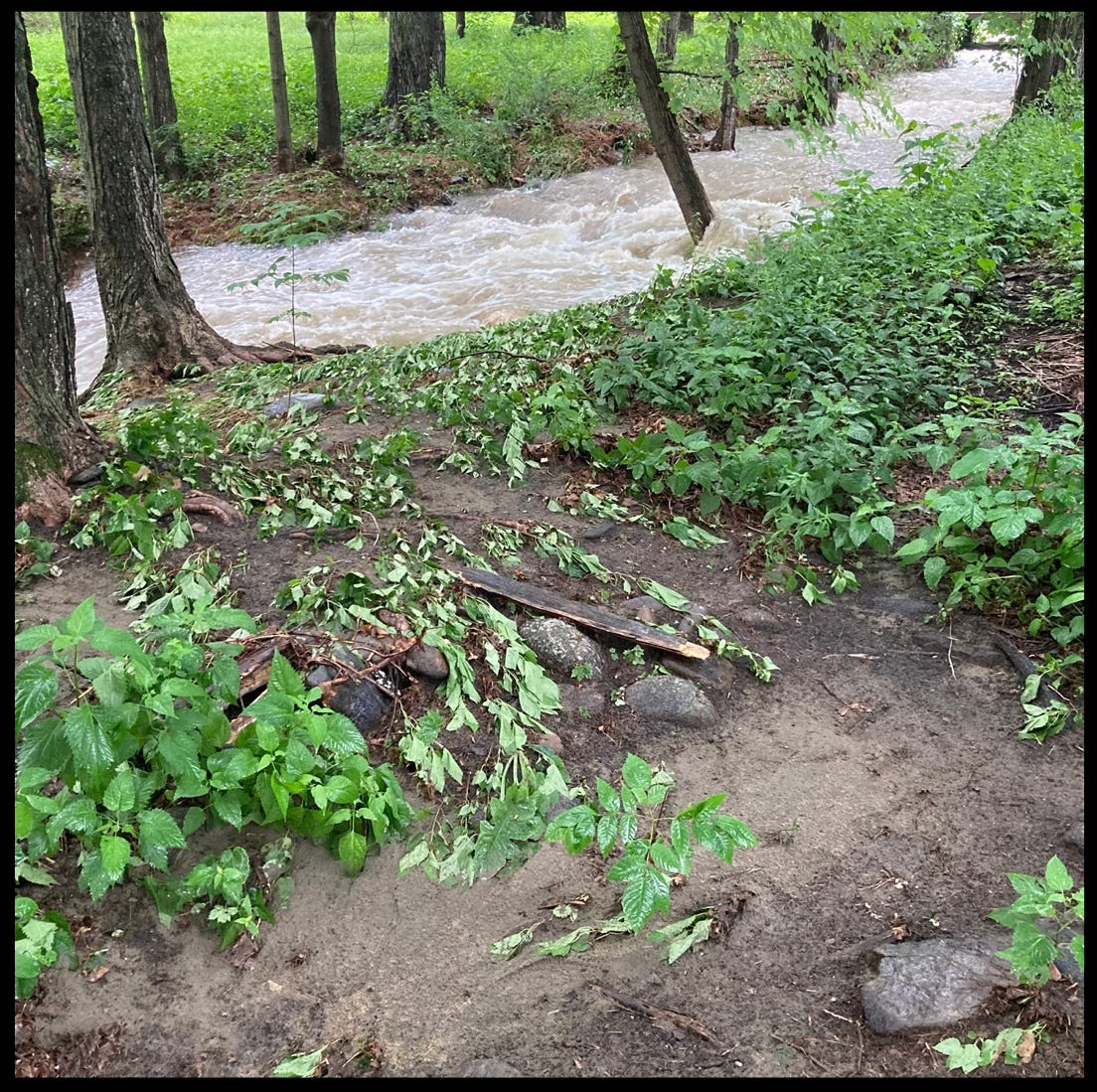
I remember visiting John the next day, and he mentioned that he had gotten up in the night to the thundering reverberations of boulders rumbling down the brook. When I investigated the damage, I saw that maples growing along the bank had been gouged bare along the base of their trunks where rocks the size of kitchen sinks had bashed them in the tumult.
But I diverge. I intended to focus on drought, not flood. Back to 2022.
As summer progressed that year, and the water table continued to drop, long-established trout pools began to evaporate. I caught as many aquatic creatures as I could wrangle, and moved them further upstream to where there were still viable pools and flowing water.
The problem with drought is that an inverse reaction occurs as streamflow recedes. Water temperature rises, while dissolved oxygen content dwindles. Fish begin to asphyxiate.
It was around this time that I began to notice reddish swaths along the stream-bed. At first glance I assumed this was a type of algal growth, correlating to the decreasing water quality. When I looked closer, I realized I was looking at pure garnet! These little gemstones ranged in size from that of a sand grain to a large pea. Because this mineral is relatively dense in composition, numerous alluvial bands formed all the way down the course of the brook.
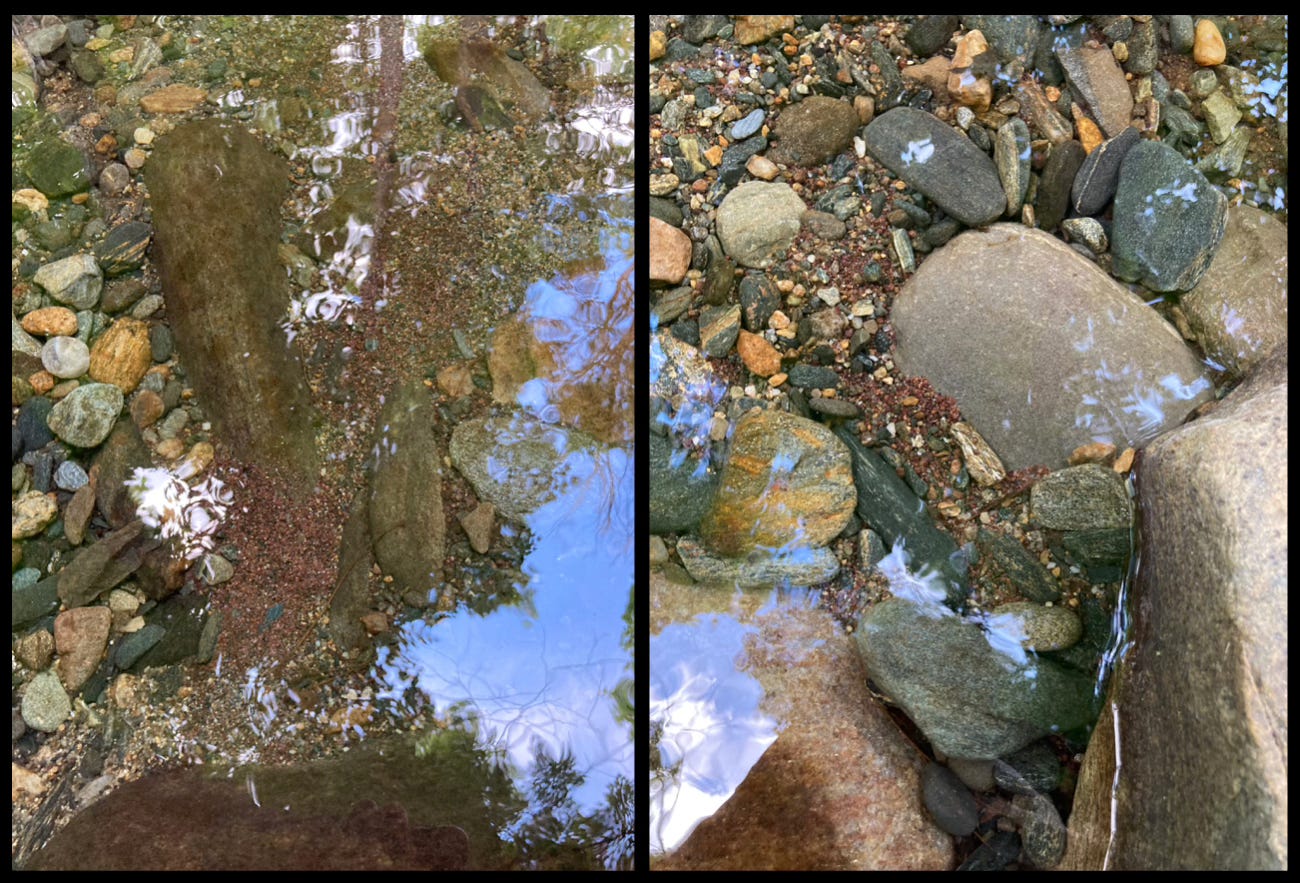
When the sun radiated through the emerald canopy of sugar maple leaves and illuminated shallow pools, these garnet shoals glowed like rubies. I’d long known about the geological formations in our local mountains containing schist embedded with garnet, but I had no idea how prevalent it is. The finer silts and pebbles (granite, feldspar, quartz, mica, tourmaline, among others) that settle between the larger rocks in the stream are all eroded pieces that have been pulverized over eons, slowly sifting down from the hills.
Though the water levels continued to shrink that summer, I couldn’t help but be enraptured by the appearance of these tiny jewels. Perhaps the single most amazing thing I discovered was that some of the stream’s macro invertebrate species — perhaps stonefly or caddisfly — had incorporated the pomegranate-colored grains into their protective larval casings. These tiny “homes” were plastered to the stream-bed cobbles.
***
By September, 2022, our little brook had completely dried up. John told me he had never seen it like this in all his years. Before the last drops vanished, I spent one evening gathering as many fish, salamanders, and macro invertebrates as I could catch, and put them in a five gallon bucket filled with stream water. I drove several miles west, to a larger spring-fed brook that was not in serious danger of drying-up, and released these aquatic refugees into their new sanctuary.
Over the last couple of years, the backyard brook has not dried-up the way it did in 2022. I am keeping my fingers crossed that it doesn’t happen this year. I’m also taking precautions.
I go to the stream everyday, to gather a few watering-can’s worth of water, and to monitor how things are faring. A pair of green frogs live in one particular pool I frequent, and they have gotten so used to my comings-and-goings that they don’t jump away when they sense the vibrations of my footfalls.
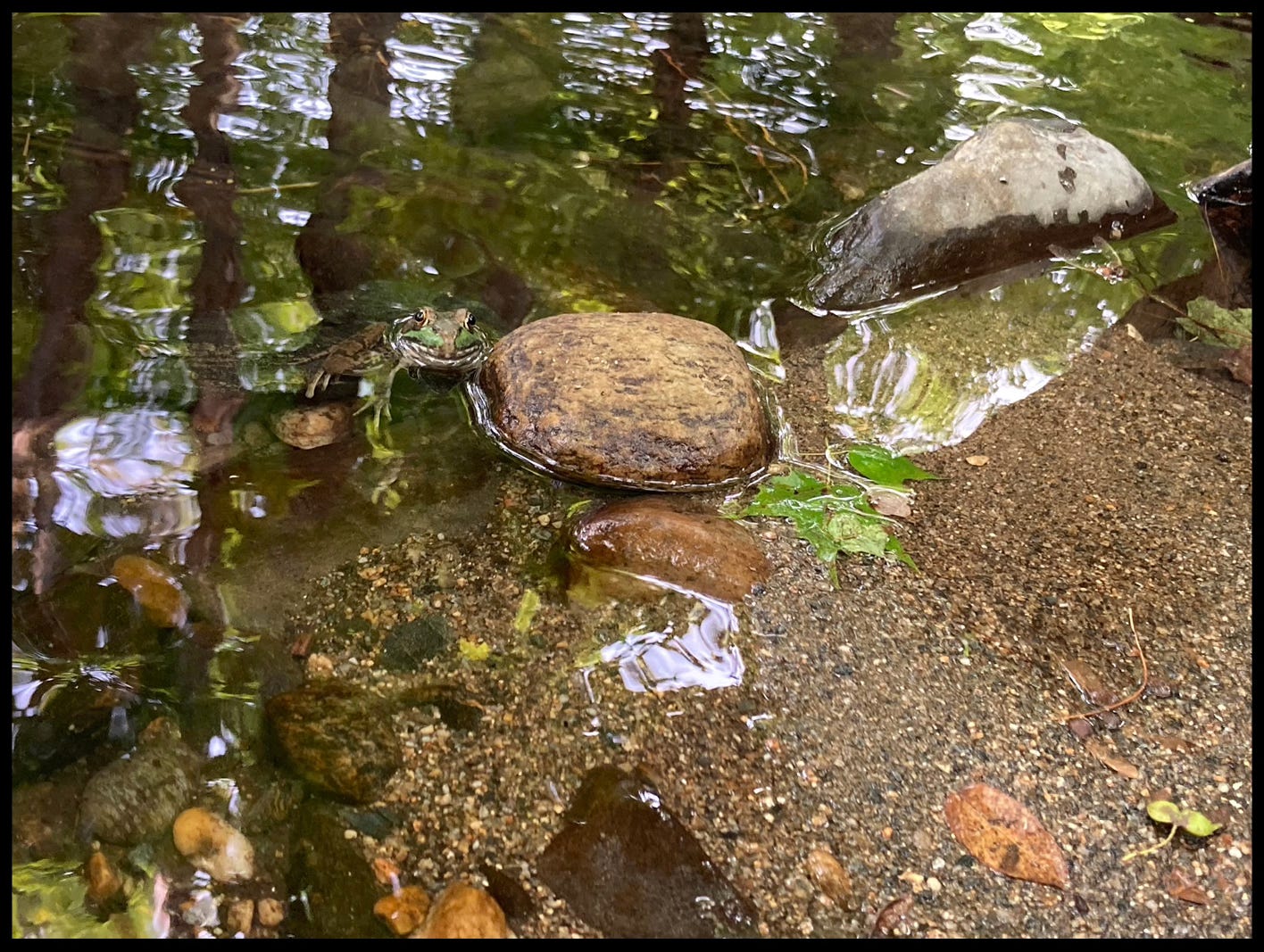
During the previous two days — which were beastly hot and sunny — I spent considerable chunks of time constructing a rudimentary dam just below the frog pool.
First, I wove branches across a stretch where larger boulders were firmly anchored. Next, I packed as many leaves as I could from last fall in and amongst the branches, before dumping several-bucketfuls of gravel to properly stopper the water from seeping through.
The results, though small, have worked. The frogs are relishing their new pool, and I’ve already spotted brook trout fry peeking out from under one of the larger rocks. I also engineered a mini fish-ladder by terracing several layers of flat stones, to allow fish residing downstream access to some of the extant pools further up if the situation worsens.
***
At one point in my life I used to travel quite a bit for work and pleasure. Over the last decade or so, for various reasons — environmental concerns being paramount — I have chosen to stay hyper-local. As some of my close friends are well aware, I have become somewhat of a “radical bioregionalist.” By this I mean I do not drive beyond about 45-minutes in one direction — even this is a rare occurrence.
I firmly believe that had I not developed such a strong affinity with the little brook, I would have missed the treasure that revealed itself as its water receded. It is often only when we slow — or stop — our perpetual motion and quest for the novel and exotic, that everyday moments of beauty uncloak themselves for us.
Perhaps one of the reasons why contemporary culture promotes far-afield adventure is because it distracts us from what is going on directly in front of (and within) us — both what is beautiful as well as what has been degraded and diminished. Aldo Leopold writes, “One of the penalties of an ecological education is that one lives alone in a world of wounds. Much of the damage inflicted on land is quite invisible to laymen. An ecologist must either harden his shell and make believe that the consequences of science are none of his business, or he must be the doctor who sees the marks of death in a community that believes itself well and does not want to be told otherwise.”3 Staying put, when most of society rushes onward, provides both blessings as well as challenges.
Climate scientists have been declaring for years that every infinitesimal degree of temperature increase we can avoid is paramount. Yet the vast majority (coincidently a very small percentage of the entire human population) of people who are aware and purportedly concerned with these dangers, choose to carry on as usual. The opportunity exists to make a significant difference in this regard, i.e., by drastically limiting or completely eliminating extraneous travel, particularly flying to distant places. Meanwhile, the droughts, fires, and floods become more frequent and devastating, occurring in wider and wider circles.4
***
My neighbor, John, slowly closing-in on 90, told me recently that there used to be a spring just across the street from his home. Apparently it trickled right out of the bedrock atop a small hillock covered in maple and oak. He can’t remember the last time water flowed from this seep.
In the haunting ending of the Pulitzer Prize-winning novel, “The Overstory,” Richard Powers reminds us of the importance of “stillness,” and that there is “still” time to correct many of our ecological and societal wrongs; two facets inextricably intertwined, but which nevertheless require our most urgent attention.5
There are still native brook trout enlivening the waters of my backyard stream, and for this I am deeply grateful. Yet these ethereal creatures, like so many more across the globe, are being relentlessly pushed to the brink of existence. Let us move gently, forward as we must, conscious of those other lifeforms with whom we share this wondrous planet.
Cormac McCarthy, “The Road,” (New York: Alfred A. Knopf, 2006) p. 241.
Robinson Jeffers, “The Tower Beyond Tragedy,” https://www.poemhunter.com/poem/the-tower-beyond-tragedy.
Aldo Leopold (Edited by Luna B. Leopold), “Round River: From the Journals of Aldo Leopold,” (Minocqua, Wisconsin: NorthWord Press, Inc., 1991) p. 237.
Please read Elizabeth Lukehart’s (the suburban wilderness) two-part essay about traveling:

Richard Powers, “The Overstory,” (New York: W.W. Norton and Company, 2018) p. 502.
deep indeed, Namaskar