
Foxfire Memories

“In a dark time, the eye begins to see…” — Theodore Roethke
“Sometimes I think that is all we are really here for: to look at the world, and to see as much as we can.” — John Haines
There was a time in my life when I routinely ventured into the late summer or early fall woods without a headlamp and before the advent of smartphones and their associated “flashlight” capabilities.
Oftentimes the forest was sodden from a recent thunderstorm, and the woodland canopy resounded with a chorus of katydids and other night-strumming insects.
Walking at night, in pitch darkness, allowing one’s eyes to adjust to the gloom, is enough to spark a feeling of entering true wilderness — even if the actual location is far from legitimately remote haunts.
Peripheral vision heightens; one’s whole body becomes sensate. Though not attuned to the degree of say, a deer, or coyote, a state of animalistic alertness is nevertheless attainable.
***
On one such walk, many years ago, after sufficient distance and time had passed to allow my eyes to fully adjust to what faint ambient light there was, I gravitated to a blue luster emanating from the edge of the path.
I had never encountered bioluminescent fungi before, but surmised this must be what I had stumbled upon. Without a source of artificial light to confirm my sighting, I was able to savor the delicate glimmer without “knowing” exactly what it was.
John Hay, describing such phenomena in his book In The Company Of Light, references Fungi Folklore by Walter Philip Kennedy Findlay:
“Luminous wood has long been known by woodmen and forest workers. It was used by people in the far north for lighting their paths through the forest during the long winter nights, as Klaus Magnus related in 1652, saying that they placed pieces of rotten oak bark at certain intervals on the proposed route. He also tells us that they used it as a kind of ‘safety lamp’ that by its light (rather than that of a burning torch) they may with more safety enter places full of combustible material, such as winter barns full of harvest crops or hay.”
***
In the autumn of 2017 I lived with my girlfriend at the time in a small, off-grid cabin near Morgan Bay along the coast of Maine. Perhaps because of the basic joys and quietude of the simple homestead, among other things, that period feels much longer ago than it actually was.
I recently read one of my journal entries from then, dated September 6, 2017:
“Yellow day, a.m. coffee. Heather listening to NPR downstairs. I hear from the loft news of big fires in Montana and Oregon. We’re finally expecting t-storms… foggy start… torrential downpours, thunder, and lightning. In between bouts of heavy weather everything is suddenly yellow… Yellow and white birch, popple, mountain maple, black walnut, white ash, huge swaths of goldenrod, centers of asters, black-eyed Susan’s. And of course one of the last remaining warblers — yellowthroat… The glow worms really liked the moisture — lime green — miniature lanterns.”
Around this time I felled a dead ash tree that had been leaning in the direction of the cabin. I bucked the trunk into stove lengths, then split the rounds. Some of the interior pieces were beautifully spalted with obsidian-black streaks.
Chore completed, I didn’t think about the ash for another few weeks, until one night when I went outside to take a leak beside the woodpile.
Rich aromas of autumn forest hung in the air after another rainstorm, and the fresh moisture resurrected the latent fungus that had been spreading throughout the fibers of the ash wood.
Pleased to be reunited with this flush of “foxfire,” I decided to bring one of the damp chunks of firewood up to the cabin’s loft. I placed it on a small bookshelf that I could see from where my head rested on my pillow. Perhaps this was an instinctual or otherwise preordained gesture, for as Findlay continues in Fungi Folklore, “Mordecai Cooke (1862) mentions that ‘in our schoolboy days we remember to have often carried home in our pockets a piece of ‘touchwood’ to be taken to bed with us on account of the little light that it afforded.’”
***
I find it somewhat curious and unfortunate that we, individually and collectively, remain uneasy with darkness, both literally and metaphorically. There is something still within us that expects a ferocious beast to leap out from the shadowland and gobble us whole. Perhaps this is why our species continues to ravage those last untrammeled corners of Earth, and cast powerful beams of artificial light around our cities and residences.
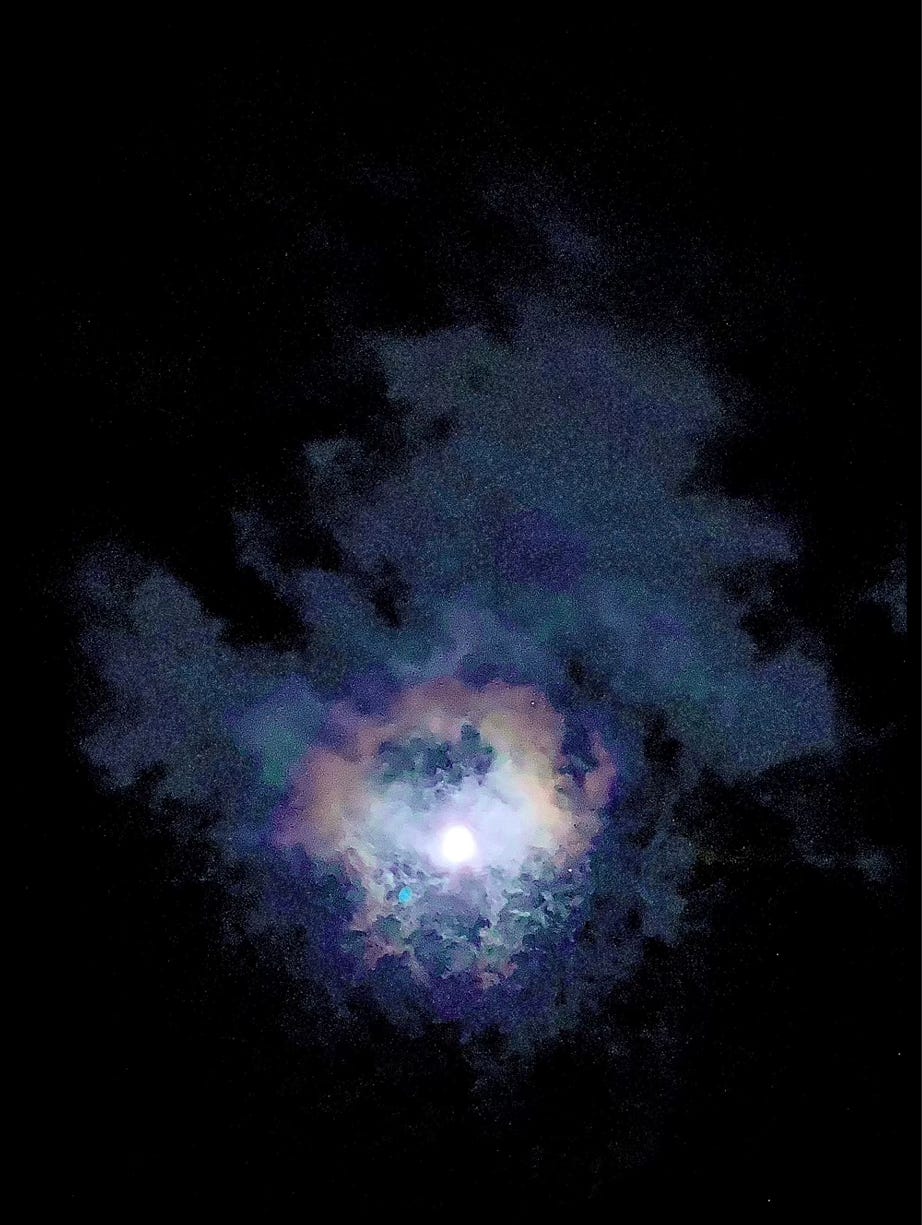
Meanwhile, the unblinking planets and shimmering stars that once offered us guidance become fainter and fainter to the naked eye. The night sky, window into the cosmos — what some refer to as “the last frontier” — has become polluted by an influx of manmade satellites and the perpetual flashes of airplane traffic.
Beauty, comfort, and wonderment await one willing to step beyond the glow of modernity, to stand patiently with ancient eyes primed to relax into the aqueous pulse of the nocturnal realm.
amazing, wow